Pages

Tuesday, 16 September 2014

Ancient History About Medo-Persia

Persia was one of the greatest empires of the ancient world. In fact, it was the Persian Empire that defeated and replaced the Babylonian Empire of Biblical fame. The Persians flourished and dominated the near-east geo-political landscape from 539-331BC. (The Bible records the fall of the Babylonian Empire to the Persians, setting the stage for the return of the Hebrew people to Jerusalem about 538-445BC, following their long period of captivity by the Babylonians that lasted seventy years from 606-536BC)
The Old Testament actually contains many references to the nation of Persia and its representatives. There are many references to the "kings of Persia," and to several of the most notable of the Persian Kings, such as Cyrus, Darius, and Artaxerxes. The prophet Daniel (8:20) speaks of the "kings of Media and Persia, and Daniel 10:13 mentions the "prince of the kingdom of Persia." The Book of Esther also refers to the dual "powers of Persia and Media.” Daniel 5:28 prophesied that Belshazzar's kingdom would be "given to the Medes and Persians. In fact, the narrative of Daniel chapter five includes the fact that Babylon fell to the Median King Darius, on the very night that Belshazzar saw the infamous handwriting on the wall.
The Persians apparently sprang from a people from the hills of Russia known as Indo-Aryans. As early as 2000BC, they began to settle in Iran and along the coast of the Black Sea. Two of these Indo-European tribes settled on the Elamite border and to the east of the Zagros mountain range. The first known references to them are made in the inscriptions of Shalmaneser III (858-824BC). They are noted as the Parsua (Persians) and Madai (Medes).
The first mention of a Persian chieftain refers to his role as an ally aligned against Sennacherib of Assyria. His son was called "King, Great King, King of the City of Anshan." His grandson fathered Cyrus II, who is one of the most celebrated kings in world history.
Cyrus II was the literal founder of the mighty Persian Empire. Cyrus II ascended to the Parsi throne located in Anshan in 559 BC. He conquered the Median King Astyages. (the grandfather of his wife) Then he defeated Lydia (about 546BC) and Babylon (about 536 BC), finally establishing the Persian Empire. Cyrus' rule was a result of the sovereignty of God. In contrast to previous rulers, especially the Assyrians, Cyrus was humane and benevolent toward those whom he defeated. It was Cyrus, the Persian king who issued the decree restoring the Jews to their homeland, following their long period of captivity by the Babylonians. (see II Chronicles 36:22-23; and Ezra 1:1-4)
Cyrus was the founder of the central governing system under which each province, or satrapy, was governed by an official who answered to the king. However, he allowed a remarkable degree of freedom of religion and customs for the vassal states, including Palestine. He developed roads, cities, postal systems, and legal codes, and treated the subject nations kindly and humanely. Cyrus accomplished all of this because he was God's tool, just as Assyria, who conquered the northern portion of Israel, was God's rod of anger. Hence the Bible usually refers to Cyrus in favorable terms (see Isaiah 44:28; 45:3)
Cambyses II (530-522BC), the son of Cyrus, reigned after his father. During his reign, Egypt was added to the list of nations conquered by Persia. The next Persian king, Darius I (521-486BC), was not a direct descendant of Cyrus but was of the royal Achaemenid bloodline. It was Darius I that was defeated by the Greeks at the Battle of Marathon in 490BC. This is the same King Darius who, in his second year, ordered the Jewish Temple at Jerusalem to be rebuilt after work on it had been discontinued for 14 years. (see Ezra 4:24; and 6:1) He also gave a generous subsidy that made it possible to complete the Temple construction. The extent of the Persian Empire under Darius is reflected in the writings of Esther. (India to Ethiopia) (see Esther 1:1; and 10:1) This vast territory was nearly 4,900 kilometers (3,000 miles) long and 800-2,400 kilometers (500 to 1,500 miles) wide.
Xerxes ruled Persia from 486 to 465BC. As Xerxes was actually Ahasuerus, he is the king mentioned in the Book of Esther. Esther did not become queen until the seventh year of his reign, which would have been about 478BC. This was two years after Xerxes devastating defeat at Salamis (480BC) which ended Persia's last hope for conquering Greece, and laid the foundation for the rise of Alexander the Great.
Another Persian king, Artaxerxes Longimanus I (464-424BC), illustrates one of the ironies of history. This minor Persian king was of major importance because of his connection with the Hebrew people. Apparently two of the three returns of the Jewish people from captivity in Babylon occurred during his reign. The second return was apparently under Ezra. This was made possible because of the generosity of Artaxerxes. The third return occurred in 445BC and is recorded in Nehemiah, and this date is notorious in the landmarks of Bible prophecy, especially as it relates to the first coming of Jesus. (Daniel 9: 24-27) The specific purpose of this return to Jerusalem allowed by Artaxerxes was to rebuild the city walls, and it also laid the foundation for the circumstances surrounding the geo-political events in Jesus lifetime.
The religion of the ancient Persians was centered around Zoroastrianism. Zoroaster believed in dualism in which Ahura Mazda (Ormazd) headed the gods of goodness (Amesha Spentas) and Angra Mainyu (Ahriman) headed the gods of evil (daevas).
After the decline of Persia, the region of Iran was left open to become one of the first countries to be occupied by the early Islamic empire which burst outward from Arabia in the seventh century. Persia has ever since maintained a distinct cultural identity within the Islamic world by retaining its own language and adhering to the strict Shia interpretation of Islam.

If you want to study more about this Ancient Story click onto this website
or this one here.
GOD BLESS YOU SO MUCH!!!

Babylon An Ancient And Famous City In Mesopotamia

One of the great cities of ancient times was the city of Babylon.  Babylon was in southern Mesopotamia near the Persian Gulf.  
The city was a sight to behold.  It had huge walls surrounding it, and in its center was a 300 foot tall Ziggurat.  The city itself was surrounded by fields, irrigated from a network of canals.  
To enter the city you passed along Procession Avenue, a stone road that led between lines of huge brick animals.  You then had to pass through the Ishtar Gate, a massive arched gate decorated with dragons and bulls.  
Once inside the walls, the city itself was very crowded.  Everyone lived inside the city.  Farmers did not live on their farms but here in the city.  Merchants, craftsmen, food vendors all made their homes here.  The streets were narrow, flanked on each side by the three story houses of the inhabitants.  People threw all of their waste and trash into the streets so they were quite filthy as well.  Every so often, the city nobles would cover the trash and filth with a layer of clay, raising the level of the streets.  People would then build steps down to their doorways or maybe even cut a new door in the second level and build stairs down to the street.   
In the center of the city was the great Ziggurat. Over 300 feet tall, it dominated the city.  In addition to the Ziggurat were the palace of the king. Inside the palace was one of the seven wonders of the ancient world, the hanging gardens of Babylon.

There are still more information to this bible story……...

For more explianing to this ancient history go to http://www.ancient.eu/babylon/ and you will surly find the truth of babylon. GOD BLESS!!!

Ancient Story About Rome

People often think that Jupiter, King of the Roman Gods, and Zeus, King of the Greek Gods, are the same god.  
But the truth is that Jupiter was as different from Zeus as the ancient Romans were from the ancient Greeks.
The Romans worshiped thousands of gods. As they expanded their empire, they discovered new gods from the people they conquered. When they ran into a god (or goddess) they liked, they adopted him (or her.) When they heard about the Greek gods, they adopted nearly all of them.
They gave the Greek gods Roman names, and acted as if they had been Roman gods all along.
But they did more than that. The ancient Romans changed some of the Greek myths to better reflect Roman beliefs. They changed some of the Greek gods' personalities to better reflect the Roman way of life. This did not happen overnight.
In Roman mythology, for example, Jupiter rarely, if ever, came down to earth. He ruled from the heavens above, and his word was final. (The Greek God Zeus, on the other hand, was forever showing up on earth in disguise, and had a great time doing it. He was terrified of his wife Hera, and somewhat ruled himself by the Fates.)
Juno, the Queen of all the Roman Gods, was motherly. Her job was to watch over the women of Rome. When she wasn't doing that, she was busy with her own children and her own household. (Hera, the Queen of all the Greek gods, was jealous and petty. When she wasn't keeping an eagle eye on Zeus, she was plotting  against any god or mortal who had angered her.)
The truth about myths is that they change with the storyteller, the civilization, the times, and the translation.
Still, the Greek myths were so wonderful that the ancient Roman storytellers and poets and writers might change some them, to bring them closer to the Roman way of life, but overall, they left quite a few of them very close to the way they found them, and treated the ancient Greek myths as great stories, which indeed they are!
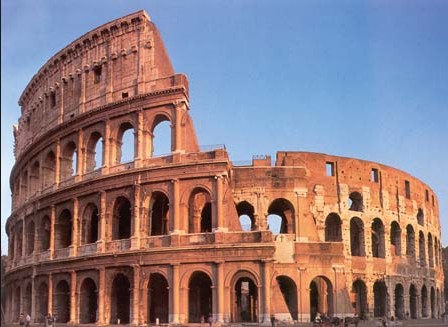
            Outside of the Roman stadium coliseum


Screenshot 2014-09-15 at 2.24.53 AM.png
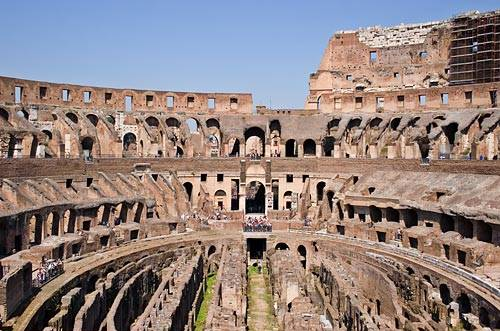
        Inside of the Roman stadium coliseum

Monday, 15 September 2014

Ancient Story About Greece

The ancient Greeks were great storytellers. They were also deeply religious. They believed their  gods and goddesses and other magical beings really existed. They believed these magical beings could interfere in their lives, to help them or to hurt them.  
The ancient Greeks built temples to honor their gods. Each temple honored only one god. So there were many, many temples in ancient Greece.
The ancient Greeks told stories about their gods. These stories are called myths (short for mythology, or stories about gods.) Some myths were so good that they have been told over and over, and still are told today. Some are new myths about the ancient Greek mystical world.  
The thing about myths is that the gods' adventures might change, but the characters remained consistent. Zeus was always the king of all the gods. His wife, Hera, was always jealous. Poseidon, his brother, always ruled the sea. His other brother, Hades, always ruled the Underworld. His sisters ruled the harvest and the home. Their kids ran everything else.
All the gods had magical powers, although not all the gods had the same powers. Whatever powers they had were consistent from story to story. For example, Zeus and only Zeus could throw lightning bolts. But many gods had the ability to shape shift - to change their shape or the shape of others. Some gods could turn into animals, and when they did, you could not tell the difference between a real animal and a god who had shape-shifted.  
This magical world was a real world, at least it was to the ancient Greek people, a world full of bickering and fights and wars and compromise and fear and fun and punishment and love. Many myths were based on the fact that gods, like mortal men, could be punished or rewarded for their actions.   
Screenshot 2014-09-15 at 4.30.22 AM.png
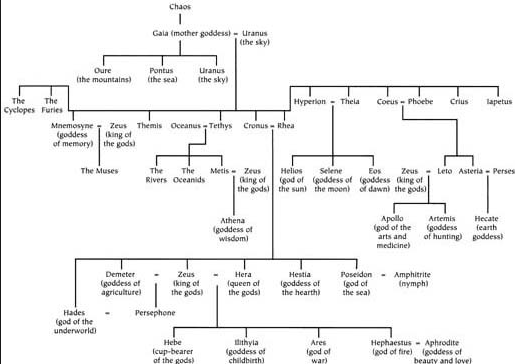
The ancient Greece family tree of there God’s
Screenshot 2014-09-15 at 4.47.07 AM.png
Zeus king of the God’s ancient Greece

Thursday, 3 July 2014

Dragon Boat


Hi this my writing about Dragon Boat. I hope that you may get heaps of information about Dragon Boats, and learn more about them I hope you enjoy. Please leave me a comment on my blog thank you.

Wednesday, 2 July 2014

Tuesday, 1 July 2014

Sunk By A Whale

In the 1820s there was a man called Captain Ahab, and he was sailing a ship named the Essex. He went out into the Pacific Ocean, to look for some whales to hunt. Most of all Captain Ahab is looking for a big white 32 meter whale called Moby Dick. 


Once they were whaling out in the Pacific Ocean, they saw the 32 meter whale and he realised it was Moby Dick. But then Moby Dick came out of no where and crashed into Captain Ahab's ship.
Captain Ahab ship called the Essex sunk to the bottom, of the Pacific Ocean but 8 people where saved by the terrifying whale.


It was 3 months later 8 of them were staving and thirsty. There were no food for them to eat and no water for them to drink. 7 of them had an idea to kill one of the youngest crew mate, on the ship. They decided to kill Owen Coffin and 7 of them ate him, and his hole body been eaten. In the end of the ship they were saved.